
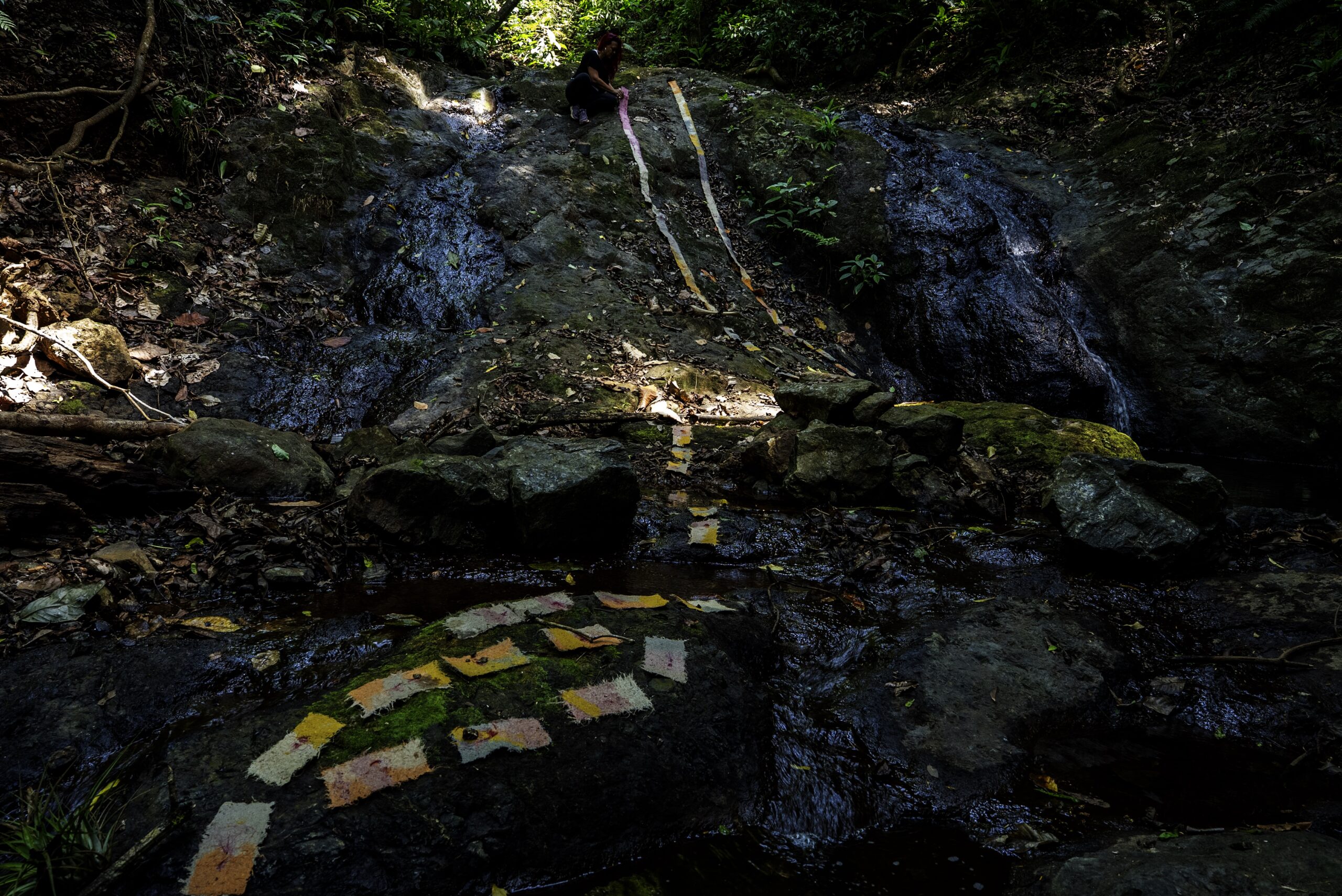
Alexandra Gelis with fibre works on the Río El Vacilón, Costa Rica, 2025. Photograph by Jorge Lozano
BROMELIAS: Inhabiting Water
Alexandra Gelis
A Space Main Gallery
September 12 – October 24, 2026
Reception September 18, 2026, 7:00 pm–9:00 pm
Artist Talk October 20, 2026, 7:00 pm–9:00 pm
Essay by: alessia prati, Fabienne Liptay
Bromelias: Inhabiting Water is a new iteration of Alexandra Gelis’s long-term project AGUA, developed through living and working alongside the Río El Vacilón, near Carara National Park and surrounding protected forest, Costa Rica.
Before the camera, there was a body learning how to walk again.
The dry bed of the Río El Vacilón became a path, but never a stable one. Alexandra learned to move slowly, listening with her feet and adjusting her body to stones, snakes, insects, sudden currents, humidity, and the changing breath of the forest. Walking became a way of filming before making an image. The camera arrived later.
Then the bromeliads became guides.
High in the tropical canopy, bromeliads grow upon trees and gather rainwater within the folds of their leaves. Water remains there, suspended above the river, forming small reservoirs where frogs, insects, and microorganisms live among sediment and decomposing matter. Each plant holds a body of water. Each body of water holds other bodies.
The river was not only on the ground. It was also above her.
Bromeliads are often mistaken for parasites and removed from trees. But what happens when we approach them as ecological infrastructures, as water keepers, habitats, and teachers? What forms of attention become possible when a plant is no longer reduced to scenery, symbol, or raw material, but encountered as a living participant in the work?
Across the exhibition, water appears as path, force, habitat, and co-maker. It cuts through terrain, gathers within leaves, transforms plant matter, and carries bodies, images, and sounds.
Moving images, sound, vibration, plant fibres, drawings, electronics, and sculptural structures carry traces of Alexandra’s encounters with water and the forest. Images move between monitors, projections, fibres, and sculptural matter. They do not sit apart from these materials. They inhabit them.
Fallen and discarded plant matter is gathered, cooked, washed, separated, and transformed with river water. The resulting fibre surfaces are not supports waiting for an image. They are already images. Already stories. They remember plant tissue, heat, hand, sediment, weather, and time.
The bromeliads, the river, the forest, and its earthbound and airborne lives guide the work across different scales: visible and invisible, macroscopic and microscopic. Walking becomes a way of occupying multiple positions at once, thinking with different parts of the body, and allowing weather, critter companions, and remnants of life on the forest floor to participate in the making.
Worlds within worlds.
Bromelias: Inhabiting Water brings these encounters into the gallery as a sensory and multidimensional environment. Moving between riverbed and canopy, between water flowing below and water held above, visitors enter a field of relations already inhabited by many other bodies and forms of life.
Biographies
Alexandra Gelis is a Colombian, Venezuelan, and Canadian media artist, researcher, and educator based in Toronto. Her practice grows through inquiry and process, spanning film and video, photography, drawing, sound, performance, and immersive installations incorporating interactive electronics and kinetic elements. She holds a PhD in Environmental Studies and an MFA in Visual Arts from York University.
Grounded in sustained fieldwork, Gelis investigates ecologies shaped by migration, colonialism, extractivism, and sociopolitical intervention. Her artistic research into the vegetal world approaches plants not simply as symbols or passive materials, but as political allies, environmental sensors, living archives, and agents of memory and resistance. Her concept Migrant Plants traces how flora move, adapt, and act within migratory, racial, and territorial regimes. Working with botanists, ethnobotanists, anthropologists, other scientists, and sabedoras (keepers of traditional knowledge), she bring scientific, ancestral, and sensory ways of knowing into relation.
Through moving images, sound, plant fibres, environmental data, and responsive systems, Gelis creates environments in which materials, technologies, and visitors enter a shifting field of relations. Rather than reproducing the places where the work begins, her installations carry the forest’s sensory and material traces into the gallery, where signals circulate among bodies, media, and environments, allowing meaning to emerge across porous boundaries. Her work has been presented in exhibitions and festivals across the Americas, Europe, Africa, and the Middle East, including Walker Art Center, Nuit Blanche Toronto, Noor Riyadh, International Short Film Festival Oberhausen, Internationale Kurzfilmtage Winterthur, Images Festival, Museo de Arte Contemporáneo de Montevideo, and Kunst Merano Arte.
Gelis directs conSECUENCIAS Collective, helps direct Earth to Tables Legacies, and co-founded converSalón.
alessia prati is a researcher and adjunct lecturer at Iuav University of Venice, where she has taught the Fashion and Performance Lab in the BA programme in Visual Arts and Fashion, and where she also completed her PhD. She previously held a research fellowship at the University of Salento and was a visiting doctoral researcher at the Centre National de la Danse in Paris (2021–2023). She is a member of PerLa – Performance Epistemologies Research Lab, directed by Annalisa Sacchi, whose research addresses performance epistemologies, critical theory, and the aesthetic-political tensions of contemporary performance.
Fabienne Liptay is a professor of film studies at the University of Zurich and co-founder of the Institute for Performance and Film Expanded. She has published widely on the theory and aesthetics of the moving image, film exhibition, time-based artistic practice and cinema expanded. Together with Liliana Gómez, she edited the book Eco-operations (diaphanes 2024), published as an artist edition with works by Alexandra Gelis.